
Forestry
School of Forest Resources
Forests are among the world’s most important resources. They cleanse the air, contribute vitally to water quality, protect the soil, provide habitats for wildlife, provide renewable raw materials for energy, shelter, and paper products, and offer recreational opportunities that enhance the quality of human life. Forests cover 21 percent of the earth’s land surface, about one-third of the land in the United States, and 89 percent of Maine–the most heavily forested state in the country.
Forestry is an applied science that involves managing forest ecosystems within increasingly complex social environments. A challenging and rewarding profession, forestry applies forest ecosystem science and conservation, management sciences, and communications skills to the conservation and management of forest resources to meet society’s ever increasing needs for commodities, services, and a healthy environment.
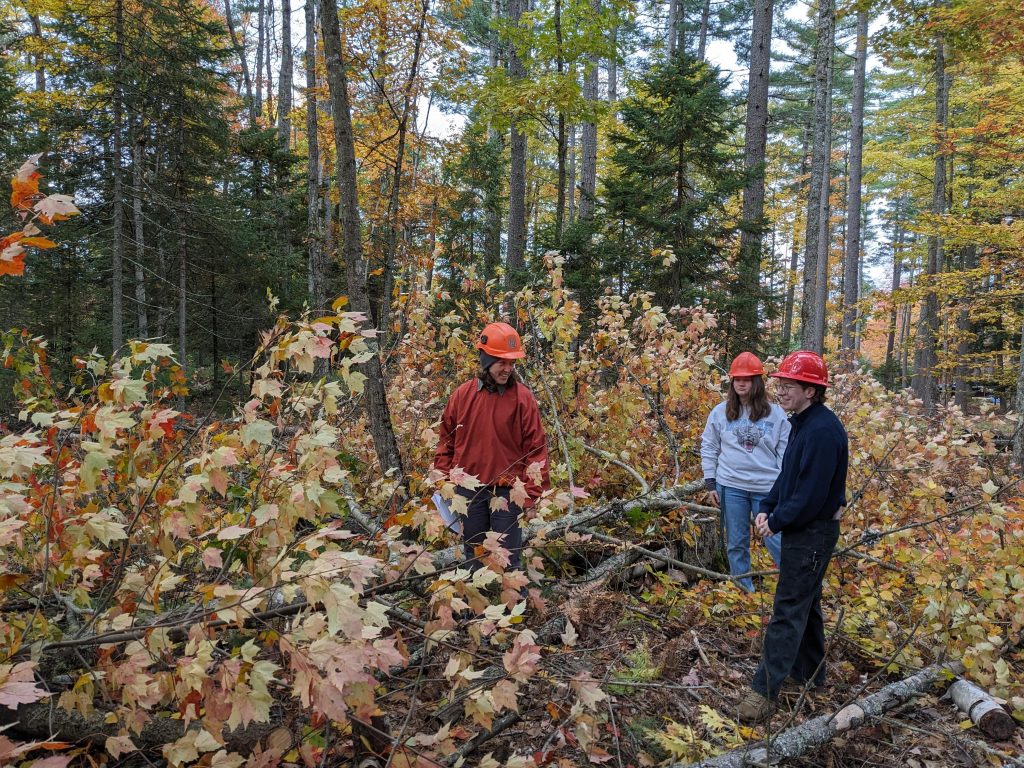
The B.S. in Forestry is accredited by the Society of American Foresters (SAF), under its Forestry standard. The four-year curriculum requires completion of 120 credits of coursework. In addition to the University’s general education requirements in science, human values, communications, and mathematics, the curriculum includes forest-oriented courses in biology, soil science, measurements, mapping, inventory, protection, ecology, tree culture, economics, policy, and administration. These are combined into an integrated approach to the management of forests for desired, sustainable conditions that respond to society’s demands for a healthy forest environment, wood-based products, wildlife habitats, recreational opportunities, and water resources. Field experiences play a large role in our program, enabling students to participate in hands-on learning opportunities.
The University of Maine’s Forestry program provides a very broad education. Foresters are employed in a wide range of positions, related to topics such as forest resources management, conservation, and land stewardship.
Federal agencies (such as the United States Forest Service, the Bureau of Land Management, and the National Park Service) manage 20 percent of the timberland in the United States. State natural resources agencies, which manage seven percent, hire foresters to manage state forest lands and to provide advice to owners of small woodland properties. Forest industries, which own 13 percent of the timberland, are major employers (especially in Maine, which ranks third in the U.S. in industrial forest acreage than any other state). An increasing number of forestry graduates become independent consultants, serving mostly nonindustrial private forestland owners, such as the thousands who own about half of Maine’s timberland. Fifty-eight percent of all of the timberland in the U.S. is in such ownership. As the people of Maine, the United States, and the world increase their demands on forests, the need for foresters will continue.
Candice Goyette
Student Academic Services Coordinator
201B Nutting Hall
Orono, ME 04469-5781
207.581.4737 | candice.goyette@maine.edu
Dr. Anil Kizha
Forestry Program Leader
217 Nutting Hall
Orono, ME 04469-5781
207.581.2851 | anil.kiza@maine.edu
Field Experience
Our network of faculty, alums, and others in the forest industry provides students with access to hundreds of internship and summer employment opportunities, but we also require that you get out there in the field and get a little dirty.
Click here to learn more
